
3 Reasons to Reconsider Training Your Dog to Heel
When we bring a dog into our lives, many of us picture peaceful neighborhood walks and calm strolls through the park with our 4-legged companion. And to achieve that picture, many of us have been taught that a “good dog” walks in a perfect heel, glued to our left side, matching every step without ever forging ahead or lagging behind.
There’s no doubt that kind of precision has its place. In certain settings, a reliable heel can be incredibly useful. But for the average family dog, it’s worth asking: does every walk really need to look like that?
Heeling on the left didn’t come out of nowhere. It has practical roots in hunting. Handlers traditionally carried their guns on the right shoulder, so dogs were trained to stay on the left for safety and efficiency. In that context, a strict heel made perfect sense. Today, however, most dogs aren’t working in the field. They’re walking suburban sidewalks, exploring local trails, and sniffing their way through neighborhood parks.
Of course, I’m not suggesting dogs should drag people down the sidewalk or turn walks into complete chaos. Good manners and safety still matter. But there’s a meaningful middle ground between total control and mayhem, one where our dogs can move with a bit more flexibility and freedom while still staying connected to us.
Here are three reasons it might be worth rethinking the strict heel on your daily walks and instead allowing for more flexibility, giving your dog the opportunity to explore, sniff, communicate, and experience a bit more choice and control:
1. Sniffing Is Essential Mental Enrichment
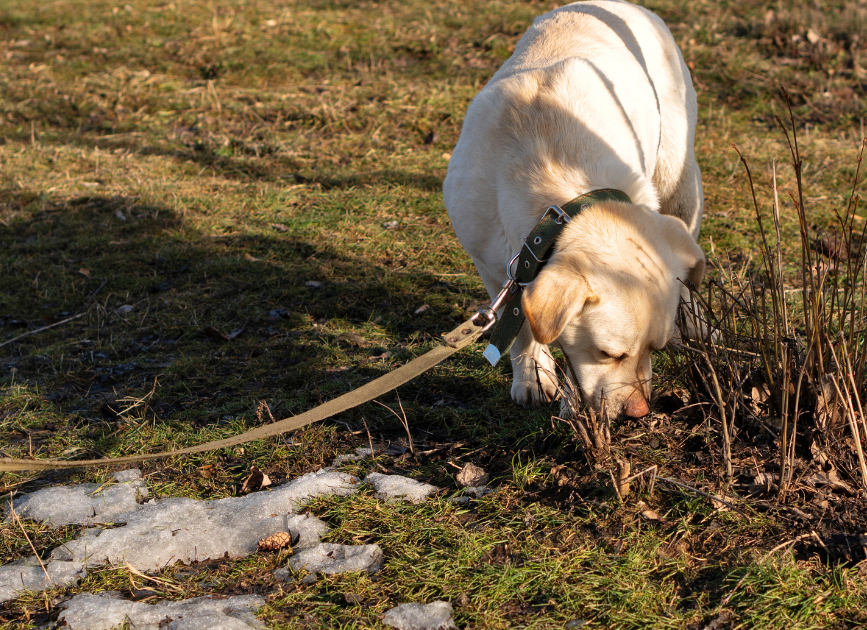
Dogs experience the world largely through their noses. Sniffing isn’t a distraction from the walk, in many ways it is the walk.
I once heard someone say, “taking a dog on a walk and not allowing them to sniff is like taking a person on a scenic drive blindfolded.” It’s a simple but (I think a) powerful comparison. When we prevent dogs from stopping to investigate their environment, we take away one of their most meaningful forms of mental stimulation.
Imagine being told you can sit in front of your television, but never turn it on. You’d likely find other ways to occupy your mind like reading, listening to music, or calling a friend. Our dogs, however, have far fewer opportunities to choose their own enrichment.
Allowing time to sniff can support cognitive health, may reduce stress, and can help meet a very real biological need. A walk that includes sniffing isn’t a lesser walk, it’s often a far more fulfilling one.
2. Choice and Control Are Fundamental Needs
All animals, including humans, benefit from having some control over their lives. Behavioral scientist Susan Friedman, PhD, describes control as a “primary reinforcer,” meaning it’s as essential as food, water and shelter.
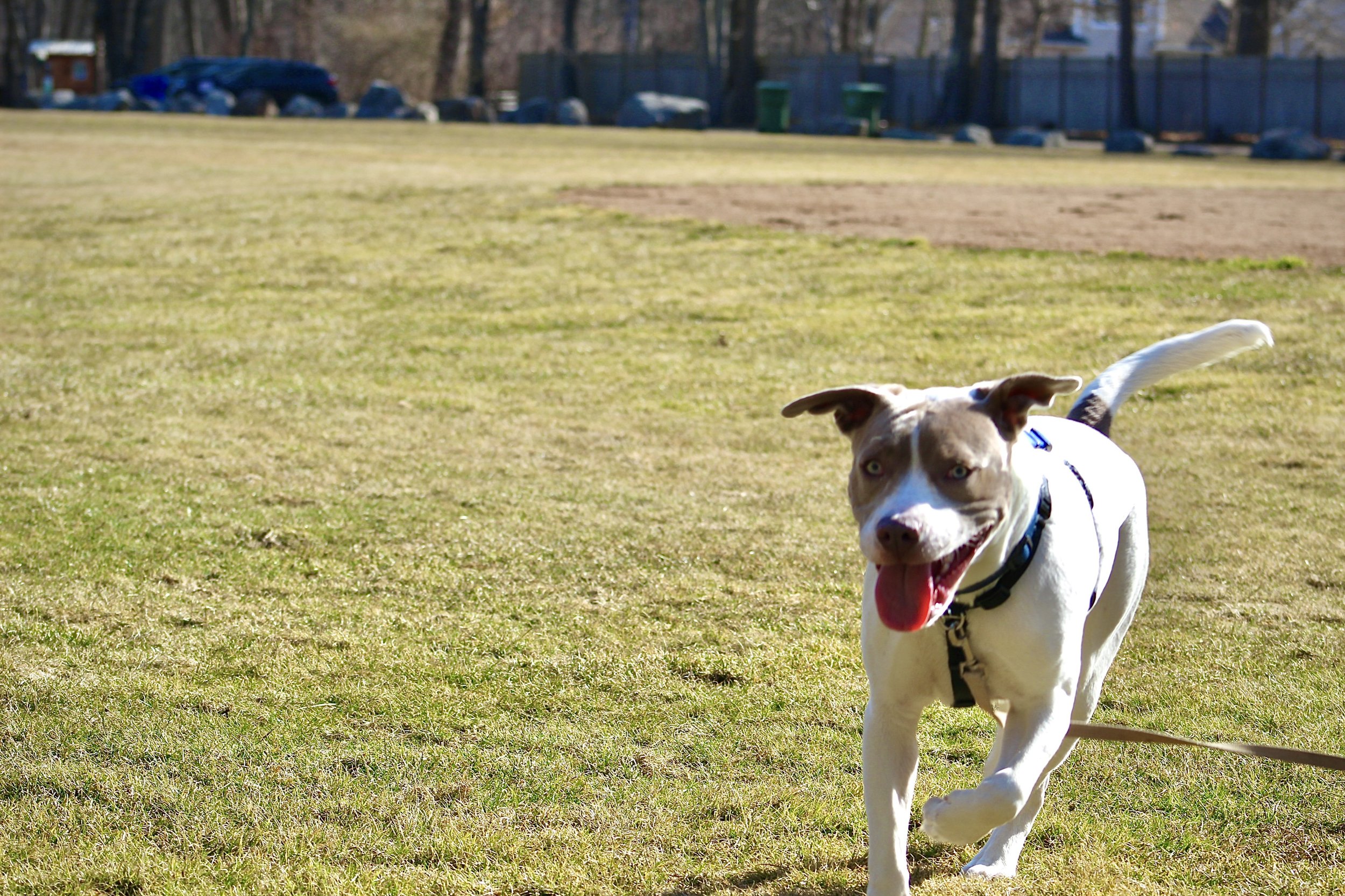
Makai enjoying the freedom to explore and make choices while staying safe on a 30-foot leash.
When we take a closer look at our dogs’ daily lives, nearly everything is decided for them. We choose when and what they eat, where they go, who they interact with, when they exercise, and how they spend their time. These choices are made with good intentions, but they leave very little room for autonomy.
Walks offer a valuable opportunity to give some of that control back. When it’s safe to do so, allowing small choices, like which direction to walk, whether to stop and sniff, or how quickly to move, can be incredibly meaningful. A bit of leash freedom (without pulling or unsafe behavior) gives dogs a sense of agency while still maintaining safe and appropriate boundaries.
These small moments of choice may seem minor, but they can have a powerful impact on a dog’s overall well-being.
3. Flexibility on Walks Supports Confidence and Communication
Our world can be overwhelming for dogs. Amazon deliveries, passing strangers, bicycles, other dogs, sirens — things we barely notice may feel intense, unpredictable or downright scary to them.
To navigate this, dogs rely on subtle but sophisticated behaviors we often refer to as “body language.” They may curve their path to create space, pause to sniff as a way to signal calm intent, or avoid direct eye contact to diffuse tension. These aren’t random behaviors, they’re important communication tools.
When we expect a rigid heel at all times, we may unintentionally limit our dogs’ ability to use these natural strategies. Allowing some movement and flexibility on leash gives them the chance to self-regulate, create distance when needed, and move through the world with greater ease.
When dogs are able to communicate effectively, their confidence often grows. When those signals are consistently restricted, stress can build, sometimes showing up as barking, lunging, or other reactive behaviors.
Finding the Balance
There are absolutely times when having your dog closely walk alongside you is useful such as in crowded areas, near traffic, or when safety requires close proximity. Teaching the skill is valuable, so you can use it when it’s needed. Expecting it at all times, though, is worth reconsidering.
Perhaps the goal of a walk doesn’t have to be perfect obedience, but rather a balance of safety, connection, and shared enjoyment.
By loosening our expectations just a bit and allowing for safe exploration, we may find our dogs become more relaxed, more fulfilled, and more confident. And in turn, our walks can feel less like a task and more like the experience we imagined from the start: enjoyable for both ends of the leash.
With wags and aloha,
Cori Tufano- CPDT-KA, FDM, CSAT

Roxi choosing how to spend her time at the park, including a well-earned rest with her favorite tennis ball.